Arigatou International is pleased to announce its membership in the Global Alliance Against Hunger and Poverty (GAAHP). Our engagement in the Alliance will be led through End Child Poverty, Arigatou International’s global interfaith initiative committed to advancing a world free from hunger and poverty for all children.
Commenting on Arigatou International’s membership, Rev. Keishi Miyamoto, President of Arigatou International, stated:
“Arigatou International is honoured to join the Global Alliance Against Hunger and Poverty. Ending hunger and child poverty is both a moral imperative and a shared global responsibility. Through our interfaith networks, knowledge platforms, and commitment to children’s dignity, we look forward to contributing values-driven knowledge and community-rooted solutions that accelerate progress toward a world free from poverty for all children.”
We join the Alliance at a time of growing global concern. Hunger, child poverty, and inequality are increasing across regions, and the world remains off track to achieve SDG 1 (No Poverty) and SDG 2 (Zero Hunger). Addressing these challenges requires renewed collective action, stronger coordination, and the meaningful inclusion of values-driven actors—an opportunity the Global Alliance is uniquely positioned to advance.
Arigatou International brings a distinctive contribution to the Alliance, particularly to its Knowledge Pillar. Through our End Child Poverty Knowledge Centre, the SDGs Academy for Children, and our wide-reaching interfaith networks, we work to generate and disseminate evidence grounded in community realities, including children’s lived experiences. We intentionally link this knowledge to theological and ethical reflection, using it to inform faith-inspired innovations, solutions, and advocacy from the grassroots to global policy spaces.
At the core of our engagement is a clear priority: addressing hunger and ending child poverty as essential steps toward building a safe, secure, and sustainable world for all children. This commitment reflects our conviction that child poverty is not inevitable, but the result of systems and choices that can be transformed through solidarity and justice.
As we begin this collaboration, we invite partners and allies to support Arigatou International’s work, the Alliance, and similar partnerships, as together we strive to secure a better, hunger-free, and poverty-free world for all children.
About Arigatou International
Arigatou International is a global non-profit organisation that brings people from all walks of life together to build a better world for all children. “All for Children” defines everything we do—for the dignity, rights, and wellbeing of every child. Drawing on universal values and the common good, Arigatou International enables people of diverse religious and cultural backgrounds to work together on children’s issues.
About the Global Alliance Against Hunger and Poverty
The Global Alliance Against Hunger and Poverty aims to better align domestic and international support to design and implement policies and programmes that accelerate efforts to eradicate hunger and poverty (SDGs 1 and 2), while reducing inequalities (SDG 10). Launched under the Brazilian G20 Presidency, the Alliance seeks to revitalize global partnerships for sustainable development and advance inclusive, just, and sustainable transition pathways.
More about Arigatou International: https://arigatouinternational.org/
More about the Alliance: https://globalallianceagainsthungerandpoverty.org/
Arigatou International’s Statement of Commitment: https://bit.ly/4sJ5rox
The post Arigatou International Joins the Global Alliance Against Hunger and Poverty appeared first on Arigatou International.

April 24, 2025
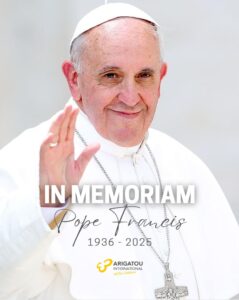
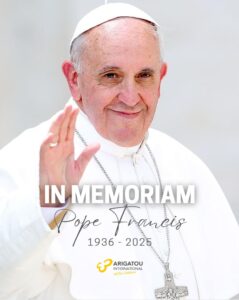
It is with deep sorrow that we at Arigatou International mourn the passing of His Holiness Pope Francis. A moral and spiritual leader to millions around the world, Pope Francis leaves behind a profound legacy of compassion, humility, and tireless commitment to human dignity, peace, and justice.
His unwavering dedication to the promotion of human fraternity and his calls for solidarity across religious and cultural divides have deeply inspired our work in interfaith dialogue and cooperation. His vision for a world rooted in shared values and mutual respect echoes the very heart of Arigatou International’s mission—to build a better world for children – through our work ethics education, intercultural and interreligious collaboration, and the promotion of children’s rights and well-being.
Pope Francis was a steadfast advocate for the protection of children from all forms of harm, violence, and abuse. He confronted painful truths with courage and called upon religious and political leaders alike to uphold their responsibilities to safeguard the dignity and safety of every child. His moral leadership on this issue challenged institutions to change and inspired countless efforts to ensure that no child suffers in silence or fear.
He reminded the world that caring for children, especially those most vulnerable, is not only a moral imperative but a sacred duty. His support for holistic education and his emphasis on nurturing the spiritual and moral development of young people have been a beacon for all those striving to create safe, inclusive, and nurturing environments for children everywhere.
At this time of mourning, we extend our heartfelt condolences to the Catholic community and all those whose lives have been touched by his words and deeds. May we honor his memory by continuing to walk the path of dialogue, peace, and solidarity—together building a future where every child can grow up with dignity, joy, and hope.
With respect,
Arigatou International
The post In Memoriam: His Holiness Pope Francis appeared first on Arigatou International.
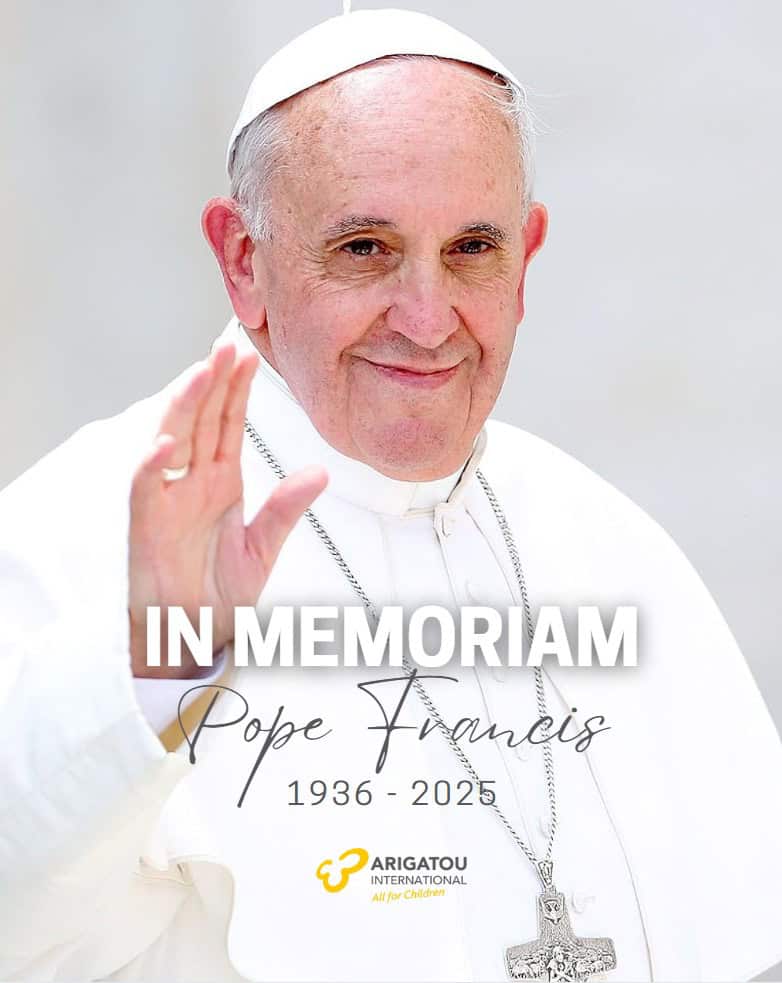
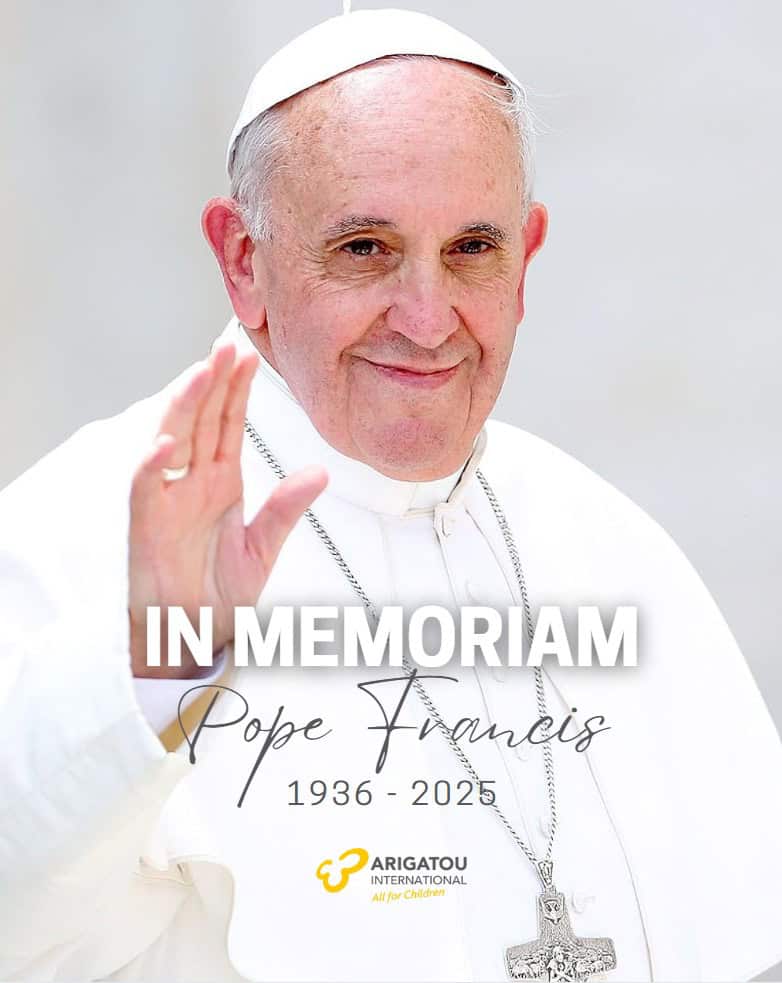
It is with deep sorrow that we at Arigatou International mourn the passing of His Holiness Pope Francis. A moral and spiritual leader to millions around the world, Pope Francis leaves behind a profound legacy of compassion, humility, and tireless commitment to human dignity, peace, and justice.
His unwavering dedication to the promotion of human fraternity and his calls for solidarity across religious and cultural divides have deeply inspired our work in interfaith dialogue and cooperation. His vision for a world rooted in shared values and mutual respect echoes the very heart of Arigatou International’s mission—to build a better world for children – through our work ethics education, intercultural and interreligious collaboration, and the promotion of children’s rights and well-being.
Pope Francis was a steadfast advocate for the protection of children from all forms of harm, violence, and abuse. He confronted painful truths with courage and called upon religious and political leaders alike to uphold their responsibilities to safeguard the dignity and safety of every child. His moral leadership on this issue challenged institutions to change and inspired countless efforts to ensure that no child suffers in silence or fear.
He reminded the world that caring for children, especially those most vulnerable, is not only a moral imperative but a sacred duty. His support for holistic education and his emphasis on nurturing the spiritual and moral development of young people have been a beacon for all those striving to create safe, inclusive, and nurturing environments for children everywhere.
At this time of mourning, we extend our heartfelt condolences to the Catholic community and all those whose lives have been touched by his words and deeds. May we honor his memory by continuing to walk the path of dialogue, peace, and solidarity—together building a future where every child can grow up with dignity, joy, and hope.
With respect,
Arigatou International
The post In Memoriam: His Holiness Pope Francis appeared first on Arigatou International.
Fashion is a global industry that encompasses the design, production, and distribution of clothing. It is one of the most influential forms of cultural expression and has a profound impact on people’s lives around the world.
Throughout history, people have used fashion to express their identity, status, and beliefs. In ancient times, garments were a sign of social rank, and people showed their allegiance to political or religious beliefs through the types of clothing they wore. In modern times, individuals use fashion to show their creativity and originality, as well as explore different aspects of their personality that they may not have otherwise discovered.
Fashion trends are closely linked to societal change and the financial interests of designers and manufacturers. However, some scholars argue that internal taste mechanisms drive changes in fashion, independent of societal influences.
Popular fashions are often close to impossible to trace: It is difficult to determine how the short skirts worn by teenagers in England made their way from there to the runways of Paris, or how hip-hop went from the streets of New York City to the haute couture fashion shows of Paris. Nevertheless, it is easy to see how fads and trends spread by watching television: the bare mid-riffs of 90210 and baggy pants from The Fresh Prince of Bel-Air are a testament to the power of mass media to influence the public’s taste.
It is also possible for individuals to use fashion as a tool for activism and social change. In this context, clothing has been used to promote awareness and support for issues such as anti-war, environmental protection, and women’s rights. By using fashion to advocate for these causes, individuals can amplify their voices and create a sense of solidarity amongst their communities.
Many of the trends that appear in fashion are short-lived. It is important for individuals to stay true to their own style, and not try too hard to fit in with what is currently considered fashionable. Individuality in fashion is a positive thing, and it helps individuals feel confident in their own skin regardless of what society says is in style at any given moment. The fashion industry uses 93 billion cubic meters of water per year, and 20% of all dyeing wastewater ends up in the ocean, contributing to microplastic pollution. To reduce the environmental impact of fashion, individuals can participate in activities such as thrifting, recycling, and purchasing eco-conscious products. They can also get involved in fashion advocacy and volunteer work. Lastly, they can make an effort to shop locally, and support sustainable brands. This will help to increase community involvement in the fashion industry, and support ethical practices that will benefit all parties involved. This will ultimately lead to a more sustainable future for the fashion industry, and a better world in general. — By Emily McCormick, Contributing Writer
The post The Impact of Fashion on People’s Lives appeared first on www.snvla.org.
Law is a complex concept, covering a broad spectrum of social rules and practices that are enforced by a controlling authority. This authority can be governmental or social. Laws cover a wide range of topics, such as human rights, property, and contract. They are derived from various sources, including customary practice, natural science, moral philosophy, and jurisprudence. Laws are also subject to a wide range of criticisms and debates, reflecting differing viewpoints.
The precise definition of the term “law” is controversial. Some scholars have argued that the word is best defined as a set of principles, enforceable by penalties. This approach is known as legal positivism. Others have taken a more expansive view of the word, interpreting it as a set of norms that regulate behavior in a specific society or context. For example, the rules that govern a particular city or state might be described as law, whereas laws that govern the entire world would be more appropriately called universal law.
Regardless of the precise definition of the term, the importance of law is widely recognized. In addition to establishing standards and maintaining order, law plays many other important roles in society. These include protecting the liberties and rights of individuals, resolving disputes, and providing certainty and stability.
A major goal of law is to ensure that all members of a community are treated fairly and consistently, regardless of their social status. This is the essence of the “rule of law,” or “law of nations.” It is a basic tenet of a democratic system and a hallmark of civilized societies. The rule of law is a necessary counterbalance to the Hobbesian war of all against all, and provides protection from tyranny and dictatorships.
In the simplest sense, the word law can refer to any binding rule or standard that is enforced by the state. It can be created by a legislature, resulting in statutes; by the executive branch through decrees and regulations; or by judges, resulting in case law. Private individuals may also create legally binding contracts that are enforceable by the courts, such as arbitration agreements. Moreover, some behaviors that people engage in instinctively or spontaneously might also be referred to as law, such as saving their lives in dangerous situations. This type of law is generally called natural law. This type of law reflects a moral stance rather than the utilitarian position espoused by legal positivism. This is particularly the case for laws that prohibit insider trading or due process, which are rooted in a moral belief in fairness and a moral opposition to cruelty.
The post The Importance of Law appeared first on www.snvla.org.